

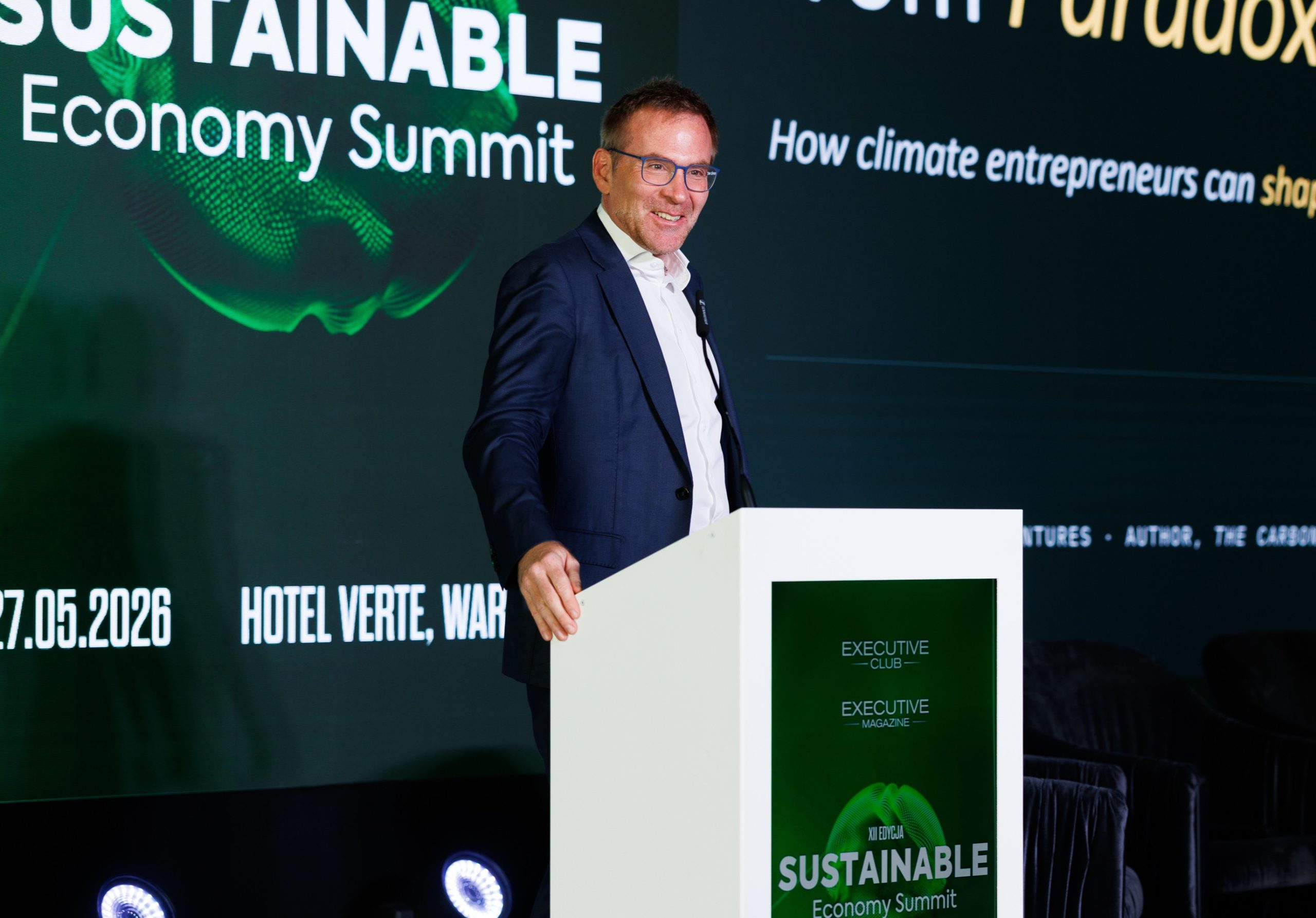
“Europe Doesn’t Need to Copy Silicon Valley”
We talk with Renat Heuberger, CEO, Terra Impact Ventures, on climate entrepreneurship as Europe’s next competitive advantage.
During your keynote at the “Sustainable Economy Summit” in Warsaw, you argued that climate action and economic prosperity are not competing objectives but mutually reinforcing factors. Why do you think this narrative still struggles to gain broader acceptance among both policymakers and business leaders?
For decades, the public debate has framed climate action primarily as a cost. We have become accustomed to talking about sacrifices, restrictions and trade-offs. While some transition costs are unavoidable, this narrative misses the much bigger picture.
Throughout history, every major technological transformation has ultimately created more prosperity than it destroyed. I believe the transition to a low-carbon economy will be no different. The companies that learn to produce steel, cement, food, chemicals or electricity with dramatically lower emissions will not simply become greener – they will become more competitive.
Europe already possesses many of the ingredients needed to lead this transformation: world-class engineering, outstanding universities, strong institutions and a highly skilled workforce. Climate innovation allows us to combine these strengths.
The problem often lies not in technology but psychology. Humans naturally focus on short-term costs while underestimating long-term opportunities. Political cycles reinforce this bias. As entrepreneurs, however, we are trained to look beyond today’s headlines and identify tomorrow’s markets.
Climate action should therefore not be viewed as an environmental obligation. It is one of the largest industrial opportunities of the 21st century.
Europe is often praised for its climate ambition but criticized for lagging behind the United States and China in scaling innovation. In your view, what are the three most important changes Europe must make to turn climate leadership into economic leadership?
First, Europe needs to become much better at scaling companies. We generate outstanding science and excellent startups, but too many of them either relocate abroad or struggle to access growth capital. We need deeper capital markets and a stronger appetite for entrepreneurial risk.
Second, regulation should increasingly reward outcomes rather than prescribe processes. Europe rightly maintains high environmental standards, but we should give entrepreneurs more flexibility in finding innovative ways to achieve them.
Third, we need a cultural shift. Failure still carries too much stigma in many European countries. Innovation inevitably involves experimentation, and experimentation inevitably involves setbacks. We should celebrate entrepreneurs who try ambitious ideas, even when they do not succeed on the first attempt.
Europe does not need to copy Silicon Valley or Shenzhen. It should build on its own strengths: quality, trust, a well-functioning legal system, engineering excellence and long-term thinking. Combined with climate innovation, those advantages can become a formidable competitive edge.
You described climate entrepreneurship as one of the defining opportunities of our time. What distinguishes successful climate entrepreneurs from traditional business founders, and what capabilities will be most valuable in the coming decade?
The best climate entrepreneurs are, first and foremost, excellent entrepreneurs. Customers ultimately buy products because they are better, cheaper or more convenient – not because they are sustainable.
What makes climate entrepreneurship unique is the complexity. Many climate businesses operate at the intersection of technology, finance, regulation and science. Entrepreneurs therefore need to bridge very different worlds.
They also need extraordinary resilience. Climate technologies often require longer development cycles, infrastructure investments and regulatory approvals before they reach scale. This demands patience and persistence.
Finally, successful founders increasingly think in systems rather than individual products. Solving climate change is about redesigning entire value chains – from agriculture and manufacturing to finance and digital infrastructure. Those who understand these interconnected systems will build the companies that define the next decade.
Through Terra Impact Ventures, you work closely with companies developing solutions in areas such as clean energy, regenerative agriculture, carbon removal and digital optimization. Which climate technologies do you believe are currently underestimated by investors and policymakers?
I would highlight three areas.
The first is regenerative agriculture. Healthy soils improve productivity, strengthen resilience against droughts and floods, support biodiversity and store significant amounts of carbon. Farmers can become key climate solution providers while improving their own livelihoods.
Second is biochar. Converting agricultural waste into biochar simultaneously creates a long-term carbon sink, improves soil fertility and can generate renewable energy during production. Few technologies offer such a compelling combination of environmental and economic benefits.
Third is digital optimization. We often associate climate innovation with large industrial projects, but software, AI and better data can reduce emissions across existing industries much faster than many people realize. Improving logistics, energy management or industrial processes by just a few percentage points creates enormous cumulative impact.
More broadly, I believe we should move beyond searching for a single silver bullet. Climate change is too large for any one technology. We need a portfolio of complementary solutions working together.
Artificial intelligence is rapidly transforming every sector of the economy. How do you see the relationship between AI and sustainability evolving?
AI is perhaps the most powerful general-purpose technology since the internet. Like every powerful technology, it can either accelerate problems or help solve them.
I am optimistic because the opportunities are enormous. AI can optimize electricity grids, improve industrial efficiency, accelerate scientific discovery, strengthen climate modelling, reduce food waste and help farmers use water and fertilizer more efficiently.
Of course, AI itself consumes energy. The objective should therefore not simply be more AI, but better AI – powered increasingly by clean electricity and applied where it creates meaningful societal value.
The greatest opportunity lies in combining digital intelligence with physical innovation. Imagine AI managing decentralized energy systems, optimizing biochar production, monitoring forests or designing entirely new low-carbon materials. That is where we will see transformative gains.
Europe faces a complex combination of challenges: high energy costs, geopolitical uncertainty, demographic pressures and increasing global competition. Yet you remain optimistic about its future. What gives you confidence that Europe can remain competitive in the decades ahead?
Europe certainly faces significant headwinds. But every major transition creates opportunities alongside challenges.
I see four enduring European strengths.
First, Europe remains one of the world’s most innovative regions scientifically.
Second, our legal systems provide stability and predictability – qualities that investors increasingly value in uncertain times.
Third, Europe has built extraordinary industrial know-how over generations. Transforming industries such as chemicals, manufacturing or mobility creates enormous opportunities for innovation.
Finally, Europe has repeatedly demonstrated an ability to cooperate across borders. No single country can solve climate change or compete globally alone, but together the European market remains one of the world’s largest economic blocs.
Competitiveness should not be measured by who produces the cheapest products today. It should be measured by who builds the industries that will dominate tomorrow.
Looking ahead to 2035, what do you think Europe’s economy could look like if it successfully combines climate innovation, digital transformation and entrepreneurial leadership?
I believe Europe could become the world’s leading high-value, low-carbon economy.
Manufacturing would become cleaner while remaining globally competitive. Agriculture would increasingly regenerate ecosystems rather than degrade them. Buildings would produce more energy than they consume. Circular business models would dramatically reduce waste. Carbon would become another managed resource rather than simply an unwanted emission.
Artificial intelligence would optimize energy systems, logistics and industrial production in real time. Climate startups founded today would have grown into global market leaders.
Most importantly, Europe could demonstrate that prosperity and sustainability reinforce one another. That would create an alternative development model – one that many other regions could adapt to their own circumstances.
The transition will not be linear, and it will not be easy. But I remain fundamentally optimistic. Human history is full of examples where innovation solved problems once considered impossible. Climate change is undoubtedly one of humanity’s greatest challenges. It can also become one of our greatest opportunities to build a more resilient, prosperous and inclusive economy.
Renat Heuberger is a serial entrepreneur in sustainability and climate action and CEO of Terra Impact Ventures. He co-founded and led the myclimate foundation and South Pole, and is chairman of eAgronom and MPower. Renat was named Social Entrepreneur by the World Economic Forum’s Schwab Foundation, is an elected member of the Innovation Council for the Swiss government, is a YPO Global Impact Award winner, and an EY Entrepreneur of the Year finalist. He serves on various boards. He holds a masters degree in environmental science from the Swiss Federal Institute of Technology and has completed executive education programs at INSEAD and the Harvard Kennedy School.
Read also: “Us Versus Them”: Populism, Power, and the Erosion of Democracy
Last Updated on July 21, 2026 by Anastazja Lach